ANS: Adjusted Neighborhood Scoring#
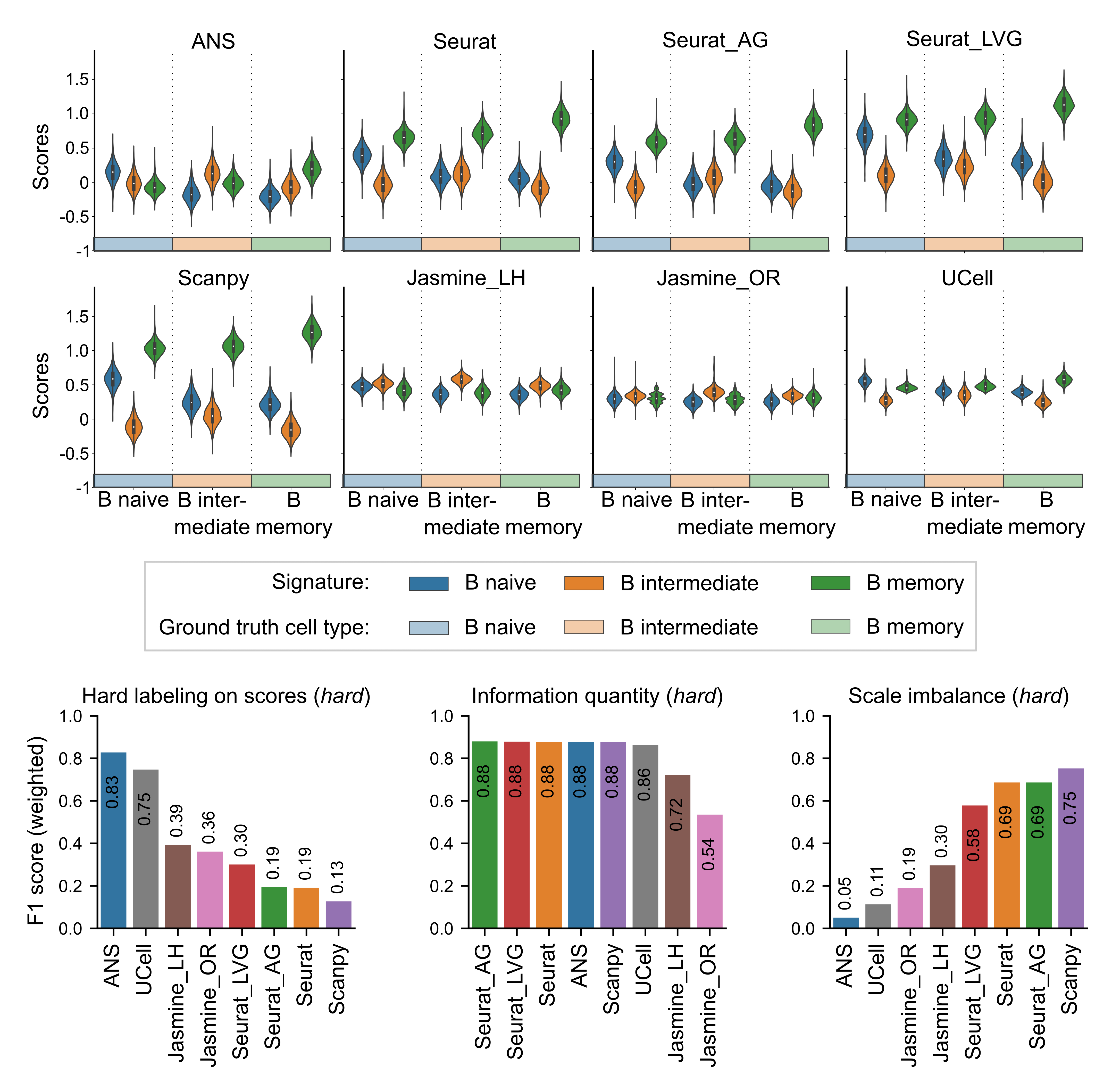
Gene signature scoring is integral to single-cell RNA sequencing (scRNA-seq) data analysis, particularly for unsupervised cellular state annotation based on maximum signature score values. However, this application requires robust and comparable score distributions across diverse signatures and experimental conditions. Our systematic evaluation of established scoring methodologies—Seurat, SCANPY, UCell, and JASMINE—across nine healthy and cancer scRNA-seq datasets demonstrates their insufficiency in fulfilling this requirement. To address this limitation, we present Adjusted Neighborhood Scoring (ANS), a deterministic algorithm with enhanced control gene selection that significantly improves score stability and cross-signature comparability, achieving cell state annotation accuracy comparable to supervised methods. We demonstrate the practical utility of ANS by developing and validating a gene signature to differentiate cancer-associated fibroblasts from malignant cells undergoing epithelial-to-mesenchymal transition. Overall, ANS provides a robust and reliable gene signature scoring framework, significantly improving the accuracy of score-based annotation of cell types and states in single-cell studies.
Note
A preprint describing ANS and showing the results of signature scoring methods benchmark is now available.
Getting started#
Installation#
We aim for Python versions 3.8+. Run:
pip install git+https://github.com/BoevaLab/ANS_signature_scoring.git
Disclaimer: The implementations of all Tirosh et al. 2016 based scoring methods are largely based on the implementation of the score_genes() method in Scanpy.
Basic usage in Python#
The package allows full compatibility with the Python scRNA-seq analysis toolbox Scanpy. The scoring methods are applied on preprocessed (log-normalized) scRNA-seq.
import signaturescoring as ssc

ssc.score_signature(
    adata=adata,                            # preprocessed (log-normalized) gene expression data in an AnnData object
    gene_list=gene_signature,               # gene expression signature, type list
    method='adjusted_neighborhood_scoring',
    ctrl_size=100,
    score_name='scores',                    # scores stored in adata.obs column defined by score_name
)

print(adata.obs['scores'].describe())
Other method values:
seurat_scoring, seurat_ag_scoring, and seurat_lvg_scoring: Python implementation of the scoring method AddModuleScore of the package Seurat first proposed by Tirosh et al. 2016 and two alternatives (this paper).
jasmine_scoring: Python implementation of JASMINE by Noureen et al. 2022. Requires an additional argument score_method with the values likelihood or oddsratio.
ucell_scoring: Python implementation of UCell by Andreatta et Carmona 2021.
Basic usage in R#
The repository contains an R implementation of the novel scoring method in the folder src_R/adjusted_neighborhood_scoring.R. The file can be downloaded, and the method can be loaded for usage.
Disclaimer: The code is largely based on the implementation of the AddModuleScore method of the Seurat package.
Note: ANS for R should be used on Seurat objects. Source the file in your script and use it identically to AddModuleScore.
Example:
source('MT/ANS_signature_scoring/src_R/adjusted_neighborhood_scoring.R')

# Initialize the Seurat object with the log-normalized data.
# e.g. Peripheral Blood Mononuclear Cells (PBMC) freely available from 10X Genomics
pbmc <- "..."

# List of signatures
markers <- list(markers = gene_list)

# score data
pbmc <- AdjustedNeighborhoodScoring(pbmc, features = markers)